You found termites. Now you have four different people telling you four different things. Your neighbor says to tent it. Your contractor mentioned heat treatment. The pest control company you called is recommending spot treatment. And your brother-in-law swears by orange oil.
All four are legitimate options. However, they are not interchangeable.
Here’s What You Need to Know
Fumigation is the most thorough option for widespread infestations. Heat treatment is an effective chemical-free alternative. Spot treatment works for small, contained activity. Orange oil is best for early-stage infestations caught before they spread. Choosing the wrong one wastes money and leaves termites in your walls.
Before choosing any treatment, you need to know what type of termite you are dealing with. Riverside County has two primary species — drywood and subterranean — and they behave very differently.
Drywood termites
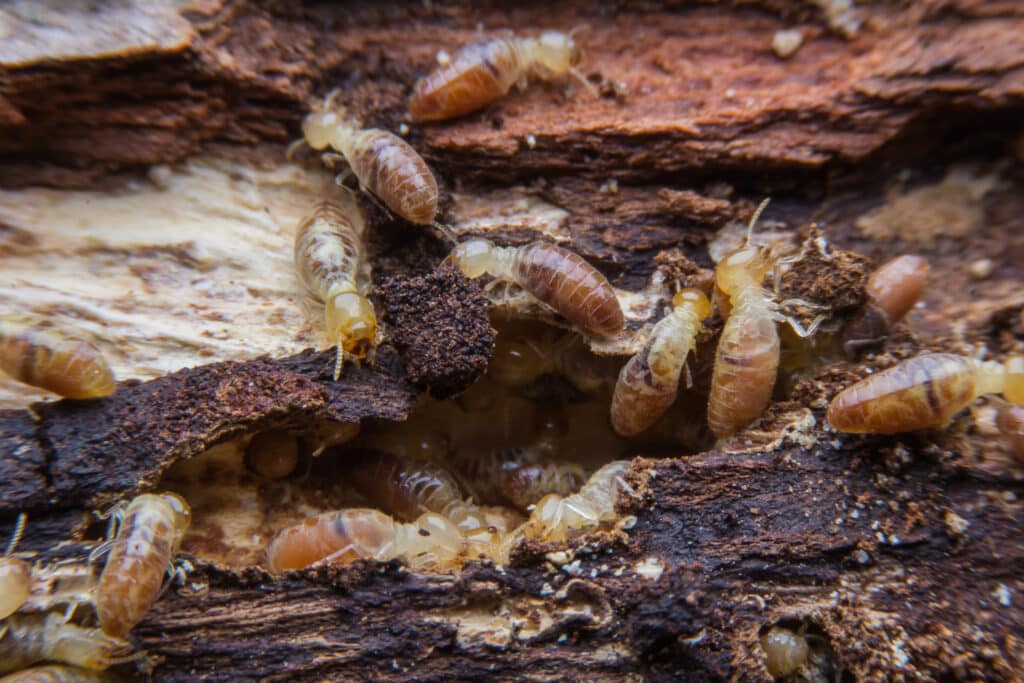
Drywood Termites live entirely inside the wood they consume. They do not need soil contact. Signs include small piles of frass near baseboards and windowsills that look like sawdust or coffee grounds.
Subterranean termites
Subterranean Termites live underground and travel through mud tubes to reach wood above the foundation. They form much larger colonies and cause structural damage faster. Signs include mud tubes along foundation walls and hollow-sounding wood near the base of walls.
For a detailed breakdown of drywood termite biology and behavior specific to California, the UC Integrated Pest Management Program is a reliable reference. A professional termite inspection is the necessary first step before committing to any treatment. Without it, any recommendation is a guess.
The 4 Termite Treatments Available to Riverside Homeowners
1. Fumigation
Fumigation — also called tenting — is the most comprehensive termite treatment available. Initally, the entire structure is enclosed in a sealed tent and a gas fumigant is released throughout the building. The gas penetrates every void, cavity, and piece of wood regardless of where termites are hiding.
What the process looks like:
- The home is sealed in a tent for approximately three days
- All food, medications, and plants must be removed or sealed in protective bags
- All occupants and pets vacate the property for the duration
- A licensed technician clears the property before re-entry is permitted
When fumigation is the right call:
- The infestation has spread to multiple areas of the home
- Previous spot treatments have not resolved the problem
- The inspector cannot fully determine the extent of the activity
- The home has complex construction with inaccessible voids
One important limitation: fumigation leaves no residual barrier. Termites can re-enter the structure after treatment. Ongoing monitoring after fumigation is not optional — it is part of protecting your investment. Southland’s termite fumigation service includes a post-treatment inspection to confirm elimination and identify any re-entry conditions.

2. Heat Treatment
Heat treatment eliminates termites by raising the internal temperature of the structure to levels that are lethal to all life stages of drywood termites, including eggs. The affected area is heated to approximately 120 to 140 degrees Fahrenheit and held there long enough to penetrate deep into the wood.
No chemicals are involved. Most homeowners return to the property the same day.
What the process looks like:
- Large heaters are positioned throughout the home or in targeted sections
- Temperatures are monitored continuously to ensure full penetration
- Heat-sensitive items such as candles, aerosols, certain plastics, and electronics need to be removed beforehand
- No fumigant residue remains after treatment
When heat treatment is the right call:
- The homeowner wants a chemical-free approach
- There are concerns about chemical exposure for young children or pets
- The infestation is concentrated in a specific section of the home
- The property has restrictions around chemical use
Heat treatment covers the same ground as fumigation without the chemicals. Therefore, for homeowners who want thorough elimination and prefer to avoid fumigant, it is a strong alternative.
3. Spot Treatment
Spot treatment targets specific, localized areas of drywood termite activity. Initially, a licensed technician drills small holes into the affected wood and injects termiticide directly into the galleries where termites are active. Entry points are then sealed.
Consequently, this is a precision approach. It works when the infestation is small, clearly defined, and fully accessible.
What the process looks like:
- The technician identifies active infestation areas through inspection
- Small holes are drilled into affected wood members
- Termiticide is injected directly into the termite galleries
- Drill points are sealed after treatment
When spot treatment is the right call:
- The infestation is small and confined to one area
- The affected wood is visible and accessible
- The infestation was caught early before spreading
- Budget constraints make whole-structure treatment impractical right now
Nevertheless, the main risk with spot treatment is missing hidden activity. Drywood termites can have multiple separate colonies in different parts of a structure. Treating one area does not address others. An experienced inspector will assess whether spot treatment realistically resolves the problem — or whether more comprehensive treatment is the smarter investment.

4. Orange Oil Treatment
Orange oil contains d-limonene, a compound derived from orange peels that is toxic to termites on contact. Like spot treatment, it is applied by drilling into infested wood and injecting the solution directly into areas of known activity.
Furthermore, it is a lower-toxicity option that appeals to homeowners who prefer a more natural approach to pest management.
What the process looks like:
- Active infestation areas are identified through inspection
- Small holes are drilled into affected wood
- Orange oil solution is injected into termite galleries
- Drill points are sealed after application
When orange oil is the right call:
- The infestation is small and early-stage
- The homeowner is seeking a lower-toxicity alternative
- The affected area is clearly identified and accessible
- The goal is targeted elimination of a known, contained problem
Orange oil does not penetrate deep into wood the way fumigant does and leaves no lasting residual barrier. In fact, it is most effective when termite activity is caught early. For a deeper breakdown of how orange oil performs against termites in Southern California, see our guide on orange oil vs. termites.
How to Choose the Right Treatment for Your Home
Use this as a starting framework:
- Small, early-stage, accessible infestation: Spot treatment or orange oil
- Widespread or multi-area infestation, chemical-free preference: Heat treatment
- Widespread or multi-area infestation, thoroughness is the priority: Fumigation
- Subterranean termite activity: Consult a licensed inspector — subterranean species require different protocols entirely
Altogether, do not make this decision based on cost alone or on advice from someone who has not inspected your property. For instance, every home is different. Every infestation behaves differently. Riverside’s warm, dry climate creates year-round termite pressure, and waiting almost always makes the treatment more complicated and more expensive.
Start With a Termite Inspection
Accordingly, the most important step before any treatment decision is an accurate inspection by a licensed professional. Without knowing the species, the extent of the infestation, and the construction layout of your home, no treatment recommendation is reliable.
Southland Pest Control has provided termite control services throughout Riverside County for over 19 years. Our licensed technicians conduct thorough inspections and give you honest recommendations based on what we find — not what generates the highest invoice.
Schedule your inspection today and get the information you need to make the right call.
(951) 653-7964 | Schedule Your Inspection